

Suppose I was hell-bent to convince you of the counterpoint that MORE teens using social media means MORE teens reading books. I’m scrupulous (some say “godlike”).
I chart the increase in 12th graders’ social media use on our best long-term survey (Monitoring the Future) for the maximum time period MTF asks this question (2018-2024). Everyone else selects only the data that proves their case. Not me! I want it all.
I then plot it against those same 12th graders’ reports to MTF of how many books they read in the past year. I don’t cite just the selected years cherry-picked to nail my point, like everyone else does. No, I want it all!
To crown my scrupulousness, I don’t just pick this final year versus that base year, both pre-selected to validate my pet hypothesis – again, everyone’s scam. No, I use standardized regression (dotted lines) that incorporate all years of data into a single trendline.
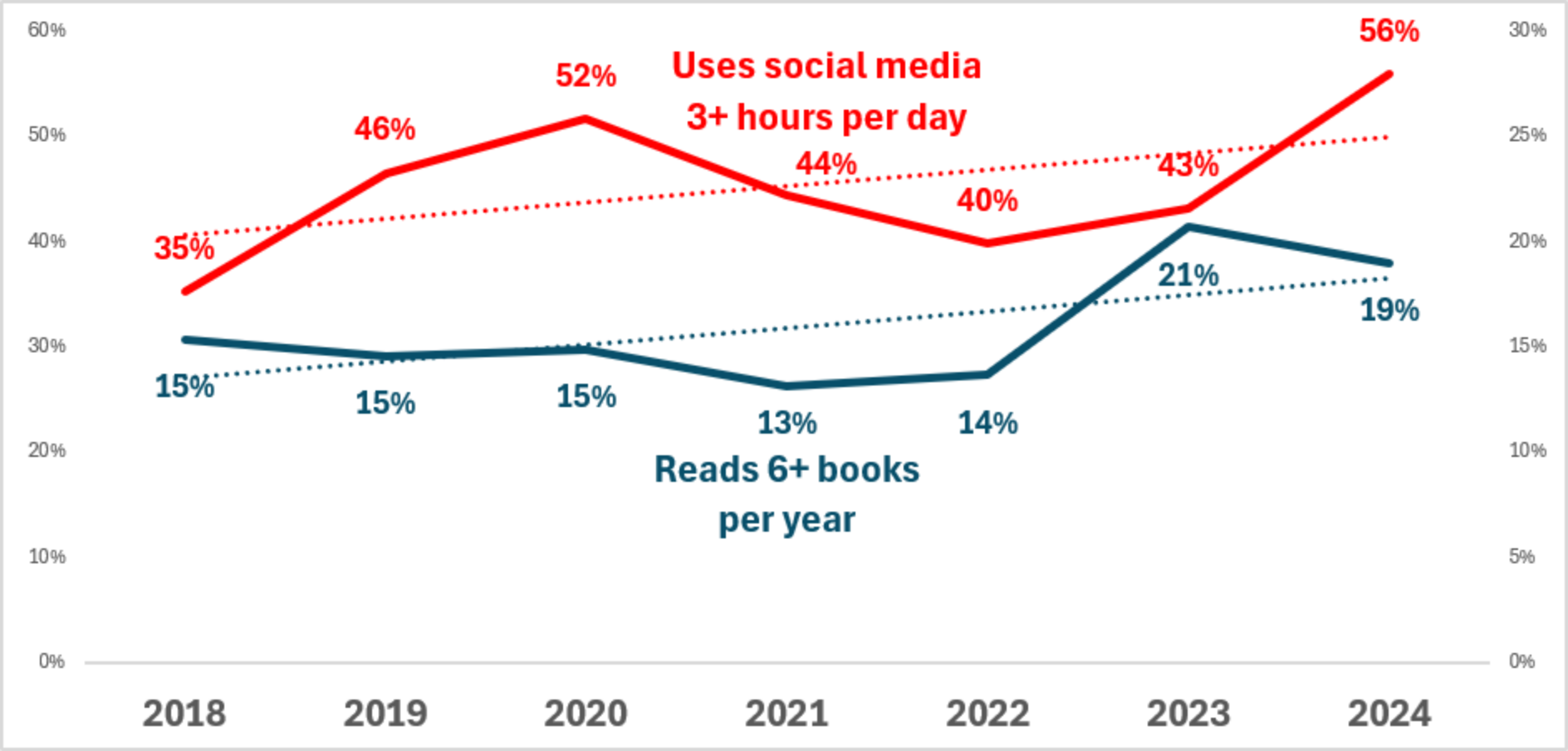
Figure 1. Percent of 12th graders using social media 3 or more hours per day accompanies more teens reading 6 or more books per year.
Source: Monitoring the Future, 2018-2024.
My honest math used to evaluate the maximum data available from our best survey yields the following result:
As teenagers’ daily social media use rose (up 24% from 2018 to 2024), the proportion reading more books also rose sharply (up 37%).
Specifically: each 1% increase in the proportion of teens using social media 3 or more hours per day accompanies a 1.5% increase in the proportion reading 6 or more books per year.
The science is clear: to boost teens’ reading, get more teens on social media.
There are no shenanigans here, I promise. Welllll… no data or math shenanigans. The shenanigan lies in my cause-effect assumption. I leave out every influence on reading except social media use.
But so what? That’s what everyone does, right? Who cares that correlation does not equal causation; the COVID pandemic, family conditions, etc., probably influenced trends; blah blah. Who in the raging social media furor is paying attention to complications?
Books are (always) dead!
Kids of every era are ALWAYS dumber, and “today’s” permissiveness, technology and culture are always to blame. Decade after decade, the critics display no critical thinking, no original ideas. Just the same-old same-old.
Socrates, I never tire of pointing out, sneered at younger generations 2,500 years ago who sullied their pure, self-contained minds with debilitating books and art.
In the 1960s, liberal-Left history professor K. Ross Toole branded my Baby Boomers tyrannical “spoiled brats” who fancied ourselves great revolutionaries but were really just ignorant “children” who never read anything.
In the early 1980s, the U.S. Department of Education’s “A Nation at Risk” report branded Gen X grade-schoolers, teens, and young adults as “illiterate,” suffering diminishing test scores, bereft of “higher order” skills, and requiring costly mass “remedial education and training programs in such basic skills as reading, writing, spelling, and computation.”
“For the first time in the history of our country, the educational skills of one generation will not surpass, will not equal, will not even approach, those of their parents,” this 1983 expert-empaneled report announced.
In The Closing of the American Mind (1987), Committee on Social Thought professor Alan Bloom (“Committee on Social Thought”? What kinda woke-ass title is that?!) further sneered that 1980s youth were “impoverished souls” debilitated “by popular music, television, and consumer culture”, abysmally ignorant of the “classical works of literature, philosophy, and art” his Boomer generation (yeah, the ignorant brats) knew.
When I went back to grad school a few years later, I heard professors repeatedly sorrowing that arriving Millennial students were grossly illiterate unteachables, unlike we erudite Gen X and Boomers of the past, formerly impoverished souls and ignorant brats now refashioned as erudite sages.
English prof Mark Bauerlein branded younger Millennials the “The Dumbest Generation” (2008). Unlike his own teenhood of wondrous, well-read older Millennials (once illiterate unteachables), scholarly Gen X (yesterday’s impoverished souls), and philosopher-king Boomers (formerly… you get the picture), young Millennials don’t read, he scoffed. Why? “Digital” and “popular culture,” of course!
“Why Gen Z doesn’t read” (psychologist Jean Twenge, who, 18 years later, uses MTF data to – as ALWAYS – blame video gaming and social media. As ALWAYS – she avoids mentioning adult reading declines in recent decades (fewer than half of adults now read even one book per year), nor that her own 1980s pre-social-media Pong-playing generation showed a far worse reading plunge than Gen Z (see Figure 2).
In 2026 Senate testimony, Harvard’s Jared Cooney Horvath slams “Generation Z” as “dominated by screens” and “the first generation to be less intelligent than their parents” — a dark deterioration from past generations whose “schools were once alive with deep learning born of human connection.” Horvath recites identical cliches heard in 1969, 1983, 1987, and yet again in 2008 to berate his own Millennial generation.
Elder inflated-egotists, nostrils-flaring for yet another chorus of, They’re so dumb! We’re so smart! can’t even think up original words to voice their scorn.
Seriously: Who are the dumb ones?
“The global reading crisis that started with smartphones,” apes yet another, a United Kingdom book publisher whose Los Angeles Times op-ed ran nationally:
“Reading for pleasure as a child is the factor that studies show is more closely correlated with future success than anything else — even more than family background, wealth, schooling or peer group. But in America right now fewer children than ever are reading for pleasure: the percentage fell from 53% in 2012 to 39% in 2022, according to a study by the National Endowment for the Arts. This mirrors data from the National Center for Education Statistics and from around the world. Levels of reading for pleasure among children were solid in every report until 2011, when they started to see a precipitous decline… It’s probably not a coincidence that 2011-12 was the time that smartphone adoption became prevalent in the U.S.”
Evidence? The op-ed cites a NEA survey showing mixed results for adults’ patronage of the arts from 2017 to 2022, an NCES tabulation showing 9-year-olds’ reading scores improved and 13-year-olds’ scores stayed the same through 2025, and a university study supported by NEA of all ages showing inconsistent changes in reading for pleasure over 20 years. What did LA Times editors who published this junk think any of that shows? None has anything to do with whether youths are reading more or less today or whether smartphones are to blame.
What Monitoring the Future does show
All right, let’s get to the “problem.” MTF has asked American 12th graders the same consistent question every year for nearly 50 years: “In the past year, how many books have you read just because you wanted to – that is, without their being assigned?”, allowing five answers of, “None, one, two to five, six to nine, or ten or more?”
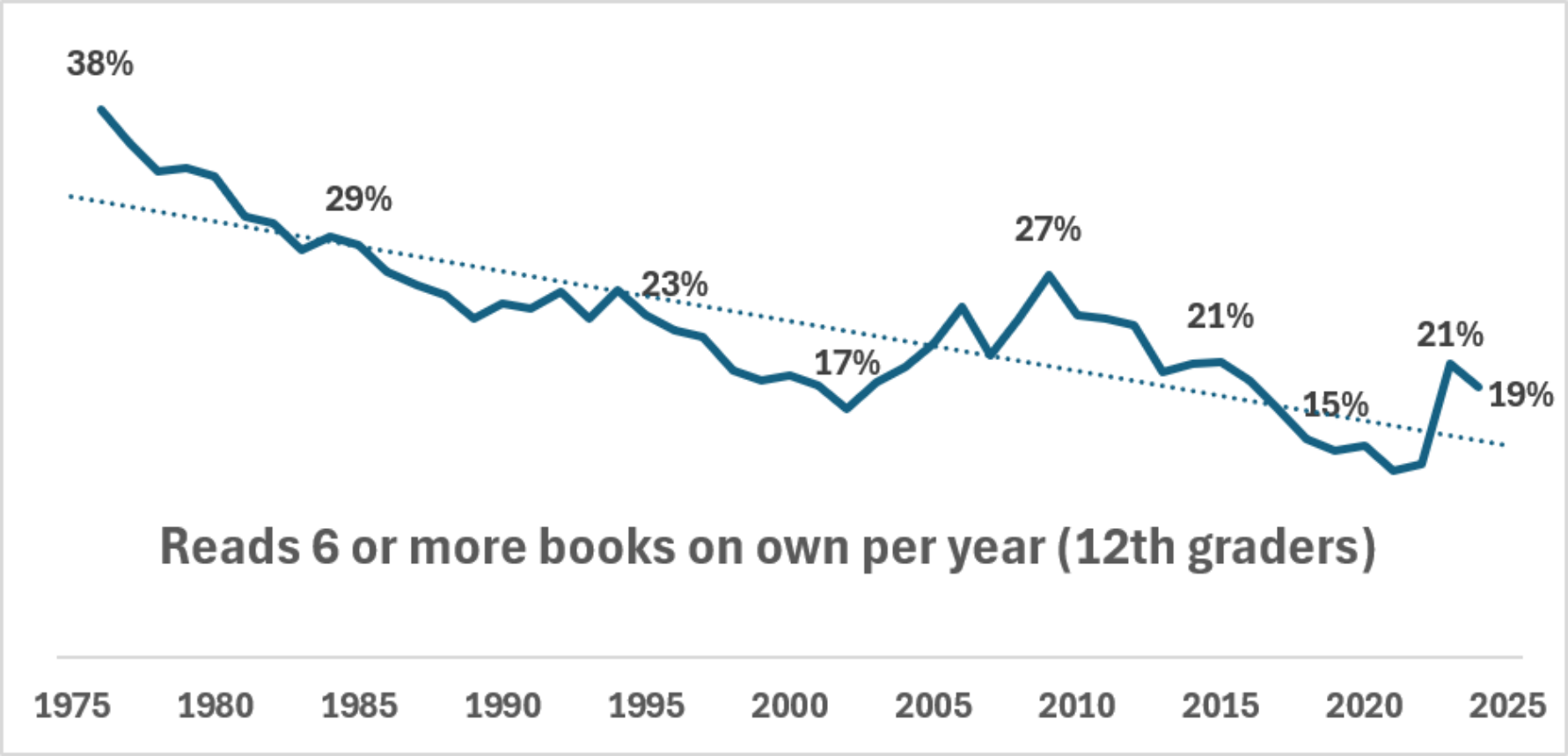
Figure 2. High school seniors’ reading, 1976 through 2024.
Source: Monitoring the Future, 1976-2024.
Clearly, students’ decline in reading did not start “with smartphones.” Any clown who bothered to do any kind of analysis would know that. But then, knowledge won’t get you published in today’s LA Times.
In fact, the proportion of 12th graders who reported reading 6 or more books per year on their own fell most sharply in Twenge’s own Xer and Horvath’s older Millennial generation from the mid-1970s to the mid-1990s (falling 0.8 points per year), well before social media was a thing.
Then, during the social media era after 1995 or so, as teen internet and smartphone use soared, teens’ reading decline fell more slowly (falling 0.4 points per year) through the late 2010s. Finally, as social media use rose sharply in the 2018-24 period (go back to Figure 1), 12th graders’ reading rose considerably (up 2.1 points per year) and is now higher than 20 years earlier.
Of course, alarmists (who selectively cite MTF when it suits them) make no mention of this trend. It contradicts everything they rage about.
Now, the larger point
Gen Z today reads books about the same as late-1990s generations, and if we go back 50 years, tracks declines in reading by grownups. Why can’t the alarmists just say true things?
More complex arguments are arising that Gen Z, following younger Millennials, has developed more diverse information access, communication, and expression modes than just reading books. Less-quoted scholars are more detailed.
“What the panic over Gen Z’s reading habits gets wrong,” Portland State University professors lament: “According to our 2025 data, a growing proportion of Gen Z – 66% – is identifying as readers, up 14 percentage points from 2022.” Further, “Gen Z often reads multimodally – bouncing between print, e-book and audiobook for the same book – and on web platforms such as Wattpad, Webtoon, Kindle Unlimited, DC Universe Infinite and Marvel Comics online.”
“Why Gen Z Is Falling Back in Love with Reading,” a Youth Talks techxpert agrees. “From cozy book cafes to BookTok recommendations, young readers are reviving literature in digital spaces. This is not your parents’ idea of reading. It is reading reimagined through aesthetics, self-expression, and a craving for calm.”
I can hear curmudgeons losing lungs. “What? Watt-toon-DC-Marvel-digital-cozy-coffee-BookTok-multimodal gobbledygook ain’t reading! Those are just excuses for mindlessly scrolling short-form video porn. Why, back in my day…”
…when second-graders debated Kierkegaard and Nietzsche…
The assumption that reading a half-dozen of the 5,000 mass-generated Harlequin romance paperbacks (hmmm… was that media “addiction”?) entitled a teenager of 1975 to claim superior intellectual status over a Millennial or Gen Z teen who reads one or two ReCOgnition sci-fi novels a year while creating their own ‘zine and multi-platform blogs but still berated as some dumbass slacker.
Well, okay… I am citing overachievers. But seriously… that’s what makes us oldsters so smart: to exploit our power to recite EXACTLY the same ego-inflating self-superiority EVERY elder for the last hundred generations has regurgitated about “kids today”?
Reminder: most over-50-agers voted for Trump.
As a GenX parent of a GenZ young adult, this rings very true to my own experience. My daughter is an avid reader, I am a lifelong avid reader, and both of my parents and grandparents all read a great deal regardless of their educational levels. My daughter is on some social media but reads print books for both education and pleasure. Having a family culture of reading and growing up surrounded by books at home, and library access is a much bigger factor in raising kids to be readers than social media usage. Kids imitate their elders. I always respond to “kids these days” screeds with “and who raised them? Who bought them the iPads and smartphones? It’s not like a 9yo can just walk into BestBuy and get that stuff for themselves….”
Many years ago when I was teaching business writing in a tertiary college, the school system changed to significantly decrease the amount of grammar and spelling being taught, and we got the first cohort of school graduates who'd been through that system.
It became a nightmare to simply move onto letter and report writing, and we had to introduce remedial English for the first time. The students weren't dumb; but their education had been compromised by ideology.
It's the same kind of fantasy-driven ideology that drives the current strategies around kids, phones, and social media.